
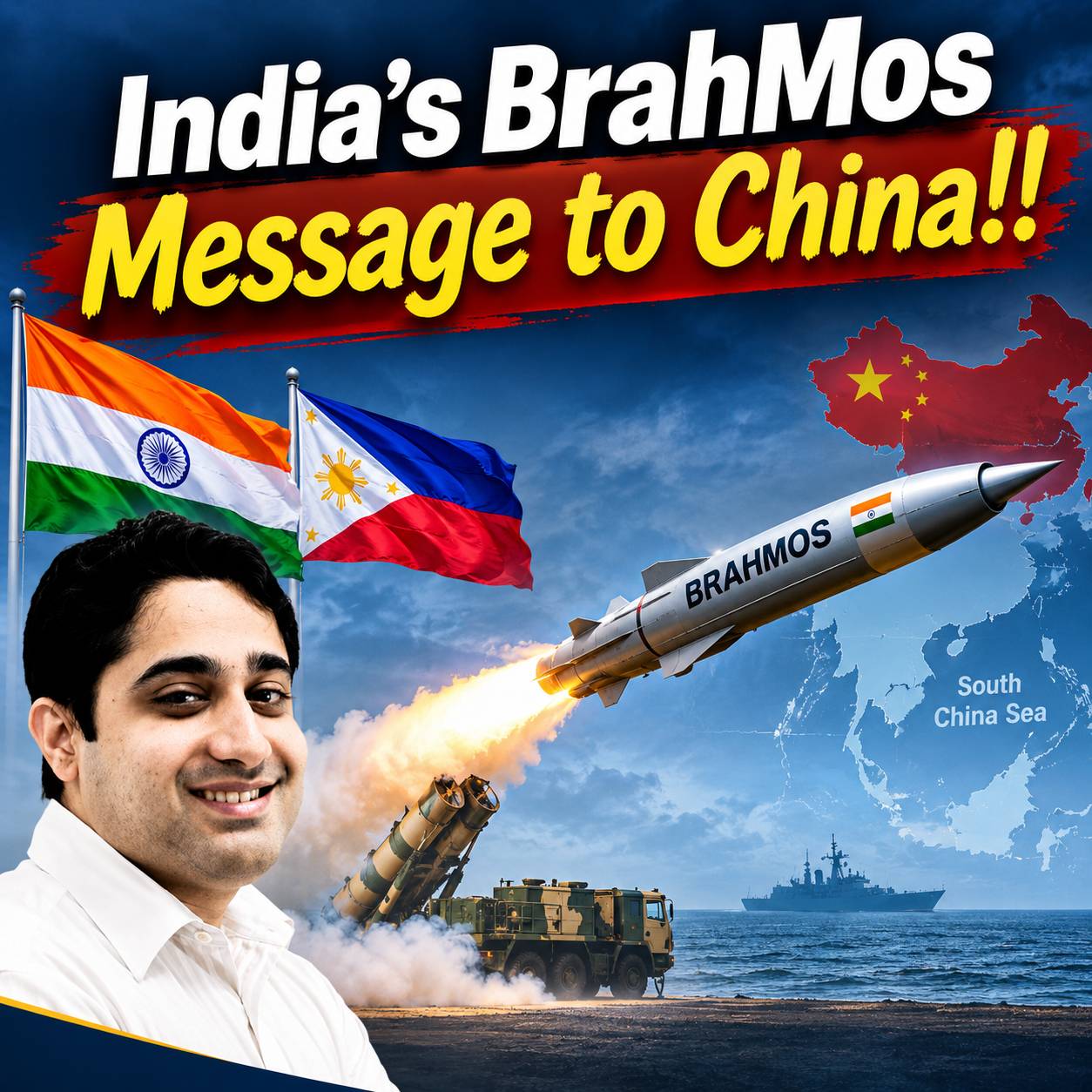
India’s growing defence partnership with the Philippines, centred on the export of the BrahMos supersonic cruise missile, is emerging as a significant development in the strategic landscape of the Indo-Pacific. More than a commercial defence transaction, the deal reflects the changing security concerns of the Philippines and India’s expanding role as a defence and strategic partner in Southeast Asia. The BrahMos missile became the first foreign customer for the BrahMos missile system when it signed a landmark agreement worth approximately $375 million in January 2022. The agreement provided for shore-based anti-ship missile systems for the Philippine Marine Corps, strengthening Manila’s capability to protect its coastline and maritime interests. India began deliveries in 2024, and the final shipment under the original agreement was completed in April 2026.
The strategic importance of the BrahMos system lies in the regional environment in which it is being deployed. The Philippines has been involved in persistent tensions with China over competing claims in the South China Sea. Incidents involving vessels and maritime forces have underlined Manila’s concern about protecting its territorial and maritime interests. For the Philippines, the acquisition of a powerful shore-based anti-ship missile system is therefore part of a broader effort to modernise its armed forces and strengthen coastal defence. BrahMos provides Manila with an additional deterrent capability in a region where maritime security has become increasingly contested. The India–Philippines defence relationship could now be set for another major expansion. According to recent reports, India and the Philippines are in final-stage discussions for an additional BrahMos purchase that could involve around five systems and nearly 60 missiles, with a potential value of $700 million to $800 million. Philippine officials have publicly expressed interest in acquiring additional BrahMos units, although a final agreement has not yet been officially announced. If concluded, the proposed agreement would represent a major boost for India’s defence exports and demonstrate the confidence placed by Manila in Indian military technology.
While the BrahMos agreement is formally a defence transaction between two sovereign nations, its geopolitical implications cannot be ignored. The South China Sea remains one of the world’s most strategically sensitive waterways, with China and several Southeast Asian countries holding overlapping territorial claims. India, too, has experienced a complicated security relationship with China, particularly along their disputed Himalayan border. The strengthening of defence ties between New Delhi and Manila therefore reflects a wider convergence of strategic interests. However, India has consistently projected its Indo-Pacific engagement as one based on cooperation, respect for international law and the principle of a free and open maritime region. The BrahMos deal should thus be seen not simply as an attempt to counter any particular country, but as part of India’s broader effort to emerge as a reliable security and defence partner for friendly nations.
The BrahMos export to the Philippines is also a milestone for India’s defence manufacturing ambitions. It has demonstrated that India is increasingly capable of exporting sophisticated, high-value military systems to international partners. The growing interest in BrahMos from countries across Southeast Asia and beyond indicates the potential of India’s defence industry to become an important player in the global arms market. India’s expanding defence exports and its efforts to develop indigenous military technology are giving New Delhi a stronger voice in the strategic affairs of the Indo-Pacific. The India–Philippines partnership is likely to extend beyond the BrahMos system. Defence cooperation, maritime security, technology and broader strategic engagement are increasingly becoming important pillars of bilateral relations. For India, the Philippines represents an important partner in Southeast Asia. For Manila, India offers an alternative and reliable source of advanced defence technology at a time when the country is seeking to diversify its defence partnerships.
The BrahMos deal, therefore, represents much more than the sale of a missile system. It symbolises India’s arrival as a significant defence exporter and a growing strategic partner in the Indo-Pacific. As tensions continue to shape the security environment of the South China Sea, the India–Philippines partnership is likely to attract increasing attention not least from Beijing.
Boddhisatya Tarafdar

